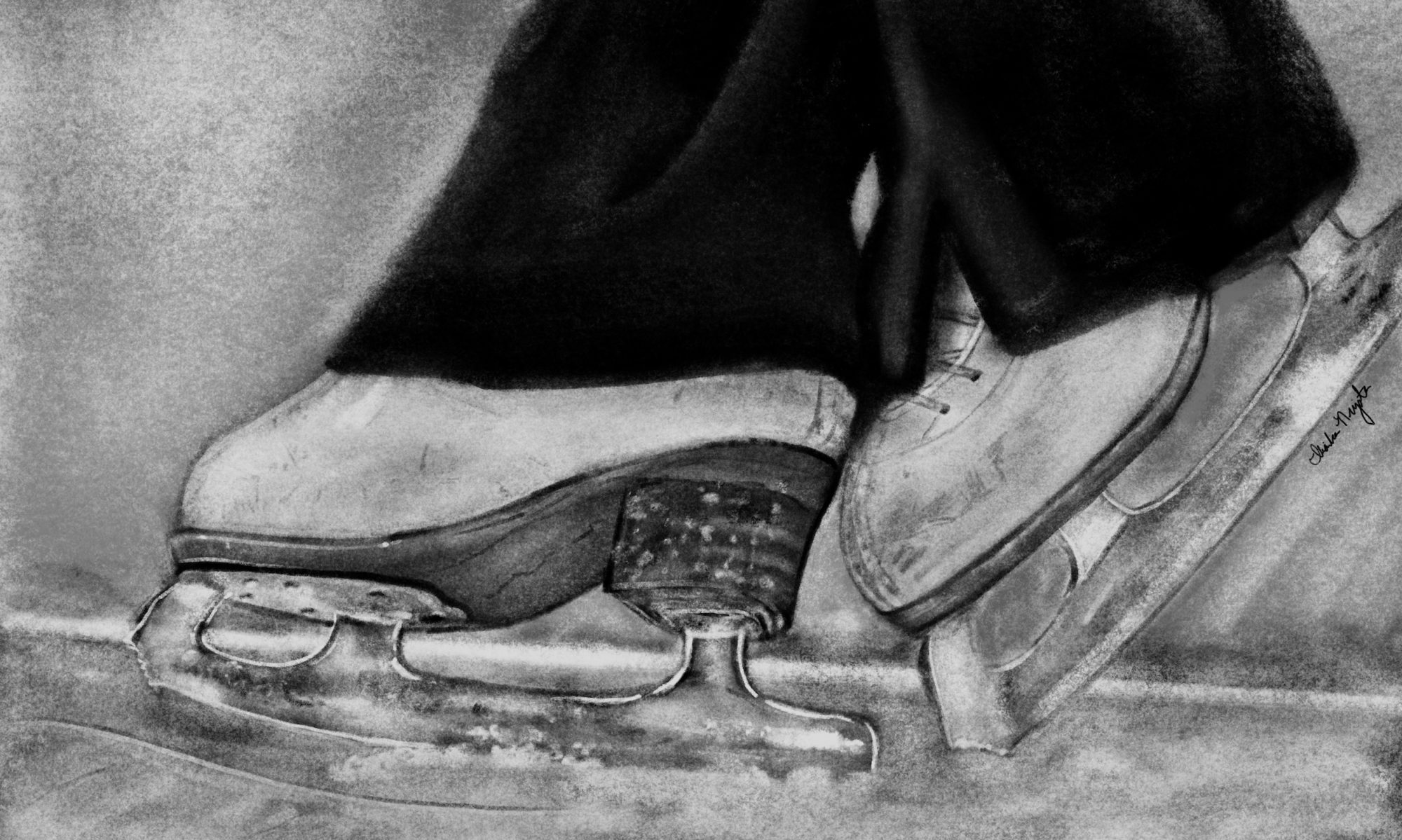

Skatergirl is working on her triple flip.
Skatercoach asked her to do ten reps, focusing on keeping her head forward on the takeoff.
This correction is supposed to keep her over her left side in the air.
Skatergirl was letting her head rotate too quickly during the takeoff, which was pulling her off axis.
Skatercoach wants her to get a few extra reps under her belt, before her next lesson.
Skatergirl does a triple flip, keeping her head forward on the takeoff.
The takeoff is much better, but the rest of the jump is much worse.
Everything feels foreign.
She can’t tell where she is in the air.
Halfway through the jump, Skatergirl bails.
She lands on two feet, well under the required rotations.
Skatergirl’s brain kicks into overdrive.
Yes, she successfully kept her head forward on the takeoff, but now there’s a different problem.
She switches into troubleshooting mode.
Now, she needs to figure out how to stop herself from opening out early.
Skatergirl analyzes the jump.
Why did she open out early?
What was the cause?
She wants to fix the problem before the end of the session, no, she needs to fix the problem before the end of the session.
Unfortunately, her zealousness backfires.
Skatergirl’s “fixes” don’t help, and in her frenzy to fix the problem she stops focusing on her head.
The jump continues to deteriorate, and she goes from making small mistakes to not being able to jump at all.
Eventually, she starts popping and circling, and by the end of the session she gets off the ice without completing any of her objectives.
Roles and their purpose
It takes a village to raise an athlete, and everyone in that village has their own role.
Coach, parent and athlete, each have roles, and each role has a specific function.
When everyone carries out their own role, they complement each other. The team gets better and starts to have the potential to function at the highest level. But, if an individual starts to step outside of their role, it can cause the entire machine to grind to a halt.
Let’s take a quick look at each role.
What are they supposed to do?
What is their purpose?
The coach
The coach’s job is to create an environment that supports learning (this includes making mistakes along the way).
They are experts in their individual field, and it’s their job to create the path the athlete travels to reach their goals.
They teach, evaluate, troubleshoot, mentor and guide the athlete along this path to reach their goals.
The parent
The parent’s job is to support the athlete unconditionally and separate from their performance and results in their sport.
When the going gets rough, their job becomes even more important.
They need to be there to help pick up the athlete when they’re down, and to make it easier for the athlete to keep moving forward.
It is very important that they do not coach as it can confuse the athlete, and can end up sabotaging the work that they are paying coaches for.
The athlete
The athlete’s job is to execute.
Nothing more, nothing less.
All they need to do is show up, learn, and practice.
When these three roles work together, progress becomes easy.
But if anyone oversteps, progress stops.
That’s why it’s important for each team member to focus on their own job.
That’s how you make maximum progress.
The athlete role
The athlete’s job is to execute, but what does that mean?
It’s simple.
They don’t need to think.
They don’t need to evaluate.
The athlete’s job is to step up and do whatever their coach tells them to do (in relation to technical knowledge).
This might sound harsh, but this is the best mindset for rapid improvement.
Let me explain.
Many athletes struggle with over evaluation.
They are hyper focused on the results, that’s all they think about.
When their coach gives them a correction, they might focus on the correction initially.
But, if something goes wrong, they forget about their coach’s correction and start searching for a fix for the new problem.
Here’s an example.
You’re prepping your double salchow for the triple.
Your coach asks you to change something on your entrance that will allow you to jump higher.
You implement the change, but, because it makes you jump higher, it messes with the feeling of the jump.
You no longer know where you are in the air, so you start landing on two feet.
This is a normal part of the learning process.
Most of the time, in order to make progress, you need to take one step back in order to take two steps forward.
Faced with this situation, most athletes react in one of two ways.
One.
Even though they’re opening out early, they keep focusing on the correction.
They do more reps, which allows their body to acclimate to the new feeling.
Eventually, their body adjusts, and they start landing the jump again.
This puts them one step closer to working on their triple salchow.
Two.
They panic and start to look for an immediate solution to this new problem.
Most of the time this means reverting their technique back to the old version.
This makes them feel better in the short term, but entirely defeats the purpose of the initial correction.
Yes, they are able to land the double again, but they haven’t improved at all.
The second reaction is an example of overstepping your role.
Remember, the athlete’s job is to execute.
Nothing more, nothing less.
If something isn’t working, you don’t need to fix it.
That’s not your job.
That is the coaches’ job.
Your job is to execute the corrections your coach gives you to the best of your ability.
Then, go to your coach for new corrections or for help troubleshooting.
The feedback loop
Improvements are made through a repeatable series of steps.
- Your coach identifies a problem and gives you a correction.
- You carry out the correction to the best of your ability.
- Your coach gives you feedback and a new course of action.
- Repeat steps 2 through 4 until the problem is solved.
Sometimes athletes try to carry out the correction and give themselves feedback at the same time.
This is bad, because they are doing their coach’s role in addition to their own.
Generally, this happens because the athlete wants to please their coach.
They want their coach to be proud of them, so they try to make it so their coach doesn’t have anything to correct.
In other words, they try to execute everything perfectly.
Yes, their coach might be happy if you execute a skill perfectly the first time, but most of the time this doesn’t happen.
Instead, most athletes get caught up in trying to be perfect, which inevitably causes them to perform poorly.
When they make a mistake, they’re already trying to figure out what went wrong on the way back to their coach.
They’re trying to figure out what their coach is going to tell them, instead of letting their coach do their job.
Don’t do your coach’s job for them.
You hired them for their expertise.
There’s a reason you’re paying them the big bucks.
Your coach is able to see the big picture.
They aren’t stuck inside the picture frame like you are.
When you try to evaluate and fix a problem, you’re searching in the dark for the correct path.
Your coach has a flashlight.
Let your coach give you corrections.
Then, focus on executing those corrections to the best of your ability.
The same thing applies outside of your lesson.
Follow your coach’s training plan.
Do the reps they tell you to do.
Focus on implementing the fixes they give you.
And, don’t evaluate on your own.
That’s all you need to do.
It’s simple.
If you can’t fully make the corrections, that’s ok.
Your coach has the expertise to know the progression of the skills you are working on.
They made the plan. You just need to follow it.
When you see your coach again, if you have done the reps, put in the time, you’ll be one step further along the path they created for you.
Trust them.
One step back
Progress isn’t a straight line.
Sometimes changes cause you to take a step backwards.
Your coach will be happy if you execute a correction they give you, even if the original skill gets worse.
After all, they gave you a correction for a reason, so if you execute it that’s a big step forward.
But if you don’t execute the correction because you want to be (what you think is) perfect, or if you revert back to your old technique, your coach will have you go back and do it again.
They want you to put in the reps so you have a baseline for your next lesson.
They want you to engrave the correction into your muscle memory.
You need to practice, not perform.
You don’t need to show off, you need to do the reps.
Once you have the reps under your belt, you’ll be better at the skill.
You can perform when you get to a competition.
Practice is not the time to be perfect.
Practice is the time to make mistakes so that you can learn.
This is a natural process, allow it to happen.
What to do instead
An athlete’s job is to show up and execute.
That’s all they need to do.
No evaluation.
No self coaching.
Follow the plan.
Here’s a simple exercise that can help you max out your athlete role:
Ask yourself this question:
What am I doing that is not my job that I want to stop doing?
What am I not doing that is part of my job that I want to start doing?
What am I doing that is part of my job that I want to continue doing?
Write down one answer to each question.
Pick one and work on it.
Maximizing your role will help you practice better, and have more fun when you see the progress.
Remove the thinking and the head trash that comes with trying to coach yourself
Focus on your job, and stop overstepping your role.
You will be surprised at the speed of your improvement.