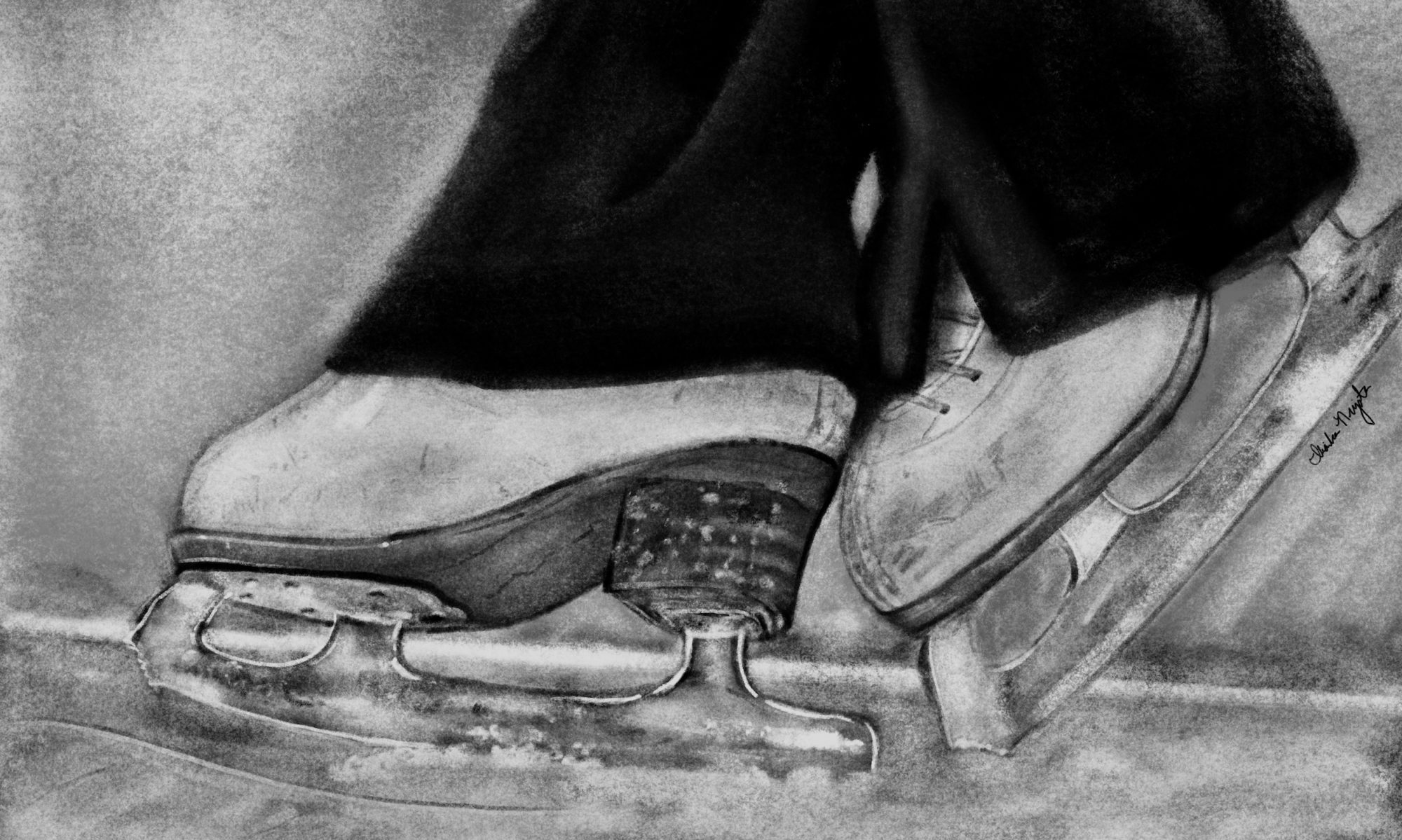

Skatergirl is working on her double lutz. She strokes around the end
of the rink and cuts across center ice. Then, she executes a right
inside mohawk, switches to a left back outside edge, and transitions
into backwards crossovers on the opposite circle.
As she approaches the lutz corner, Skatergirl places her right
toepick into the ice and vaults upwards. Two rotations later, she sticks
the landing, making sure to extend her free leg and point her toe.
A nice clean double lutz. It’s perfect, and that makes Skatergirl
happy.
Skatergirl lands three more double lutzes, each one better than the
last. After the third one, Skatercoach praises her execution. “Great
job,” she says. “Those were textbook.”
Skatercoach asks Skatergirl to complete one last rep before they
start working on double axel. Unfortunately, this proves to be a
mistake.
On the way into the jump, Skatergirl is forced to change her entry.
Little SuzySkater is standing in the center of the lutz circle,
examining the toepick holes that Skatergirl made in the ice.
Sighing, Skatergirl shifts her entrance up the ice. Instead of aiming
for the center of the lutz circle, she aims for the top of it.
However, this little change throws off her takeoff. This causes her
to put her foot down on the landing, instead of executing the perfect
double lutz she was expecting. It’s a small mistake, but it’s still a
mistake, and in Skatergirl’s mind any mistake is a disaster.
Frustration rises up inside of Skatergirl, causing tears to form at
the corners of her eyes.
Why is this happening to me? How could I make such a mistake?
This is the worst! Everything is horrible!
Perfectionism
Do you frequently cry on the ice? When you make a mistake, do you
find yourself getting frustrated enough that you can’t hold back your
tears or anger?
Are you unable to take in praise? Even when your coach is praising
you, are you stuck with the belief that your skills aren’t good
enough?
If you answered yes to these questions, like Skatergirl, you might
consider yourself to be a perfectionist. But don’t worry. Actually,
perfectionism is pretty common in the technically complex sport of
skating where milliseconds or millimeters could affect the success of an
element. Better yet, perfectionism is not random, but the result of your
behavior. Your behavior is under your control, so you can change it.
What exactly is a perfectionist? To find out, let’s examine
Skatergirl’s behavior in the earlier example.
Skatergirl did a total of five double lutzes. Four of them were
great, and only one of them had a small mistake.
And yet, this one mistake made Skatergirl frustrated enough to
cry.
Is that a typical reaction to an error during practice?
Well, unfortunately, it is more common than you might imagine. This
is like a red flag warning, “perfectionism at work, do not disturb”.
Here’s a Mythbusting question; Can you or anyone always be
perfect?
No. Absolutely not. You are not a machine. There are always things,
like little SuzySkater’s curiosity, that are out of your control. Are
you working on something new or improving your skills for the next
level, like a double to a triple jump. Are you well rested or did you
just have a huge test at school.
The amount of sleep you get. The state of mind you’re in. The quality
of the ice. The facility you’re at.
All of these things are outside of your control.
Yes, it’s important to be able to pull out a good performance even
under adverse conditions. But, does that mean you need to be
perfect?
No. In fact the search for perfectionism will slow your progress down
and might even create mental blocks.
Your job is to practice, make mistakes, learn from those mistakes and
repeat again and again. Build your muscle memory by training. Not
searching for perfection. This is the formula for building the ability
to consistently execute to the best of your ability in any
situation.
Improvement
If you want to keep improving, it’s impossible to be perfect. After
all, by definition, perfection means there’s nothing to improve.
Not convinced? Let’s look at an example from an outsider’s
perspective.
You’re a coach, and you’re teaching a skater how to do an axel. This
is the first time they’ve done a jump with more than a single rotation,
so they’re nervous.
As their coach, do you expect them to go out and land an axel on
their first attempt? No, that would be insane.
Sure, maybe one athlete in a million can do it, but the other 999,999
athletes won’t. And, that’s ok.
We humans learn through mistakes. We try to do something, fail,
change our plan, and try again. It’s called learning and it is why we
have such large brains.
Coaches accelerate this process by giving you a plan to follow, but
they can’t wave a magic wand and grant you the skill. In order to master
something new, you must go through the learning process. You must
fail.
But, most perfectionists are failure averse. In other words, they try
to avoid failure at all costs.
In fact, many perfectionists avoid anything outside of their comfort
zone, which makes it difficult if not impossible for them to reach their
athletic goals.
Taken to an extreme, perfectionism leads athletes to give up
competing or to quit the sport entirely. They make mistakes. They avoid
practicing that “thing” that they can’t do yet. They make the same
mistakes when they occasionally do the “thing” they can’t do. They get
frustrated. They feel stuck. They give up.
Escape
So, how do you escape this downward spiral created by the unrealistic
expectations? What is the best way to escape?
Well, the first step is to shift your focus away from how well you
need to do the skill. “I have to do this right.” That is an expectation.
It is a future result.
Shift your focus to DOING the skill. Bring your focus to the feeling
in your body when you are DOING the skill.
Skatergirl started shifting her focus to DOING her double lutz. Here
is what she started to notice:
- Stroking around the end of the rink
- Doing a right inside mohawk
- Doing a backwards crossover
- Vaulting off her toepick
- Pulling into an ‘I’ position
As she continued to practice DOING the double lutz, she started to
sense more and more feelings in her body:
- Her blade on the ice.
- The wind on her face.
- Her breath.
- The beat of her heart.
Skatergirl noticed she was a little less frustrated in practice, and
actually noticed some improvement in her skills. By shifting her focus
to JUST DOING the skills, she began to escape the unrealistic
expectations she created for herself.